
Abbeville County Criminal History Checks
Start with the record that best fits the question. The South Carolina Judicial Branch Case Records Search leads to Abbeville County court entries, while the Clerk of Court holds the official General Sessions file. The sheriff and detention staff handle recent local arrest and custody material. South Carolina Law Enforcement Division, or SLED, compiles fingerprint-linked events reported from across the state. None of those sources replaces the others.
Use a full legal name, date of birth, known prior names, and any case or booking number already in hand. An exact case number is the safest court key. Name-only matches need care because two people can share a name, and a spelling change can hide a valid result.
- Search the state court gateway and select Abbeville County or the known municipal court.
- Write down the case number, court, charge, status, and disposition date for each likely match.
- Ask the correct clerk for missing papers, an archive search, or a certified disposition.
- Contact the arresting agency and detention center when the event is too recent to have a full court trail.
- Use SLED CATCH for reported statewide history, then correct any mismatch with certified source records.
Abbeville County Record Hubs Compared
Local records sit at two main hubs. The Clerk of Court at 102 Court Square, Room 103, keeps General Sessions warrants, tickets, bonds, indictments, docket activity, and case outcomes. The office is open Monday through Friday from 8:30 a.m. to 5 p.m. Its main number is 864-366-5312, and the county lists extension 2201 for the General Sessions deputy clerk. The county specifically directs people seeking details about General Sessions charges to visit in person.
The Law Enforcement Center at 21 Old Calhoun Falls Road brings together the Sheriff’s Office, Detention Center, Magistrate Court, and Bond Court. Call the sheriff at 864-446-6000, detention at 864-446-6200, or Magistrate Court at 864-446-6500. This split explains why a single request may be incomplete: the incident and booking can be at Old Calhoun Falls Road while the felony case file is at Court Square.
The official Abbeville County homepage shows the county’s public offices and services.
That county directory is the practical starting point when a record has moved between sheriff, detention, magistrate, and clerk custody.
Official Background Checks in South Carolina
SLED CATCH provides a South Carolina name-and-date-of-birth report after the user accepts its terms. The standard report costs $25. Since July 1, 2026, the listed online service charge is $1.43 for each standard report. A mail request avoids that online charge but requires the SLED form, valid payment, and a self-addressed stamped envelope. Cash and personal checks are not accepted for the mailed route.
CATCH is a state repository report, not a certified Abbeville County judgment and not a sex offender search. It can be affected by aliases, a wrong birth date, or missing fingerprint and disposition reports. A fingerprint-based self-review gives stronger identity matching. Call local law enforcement first to confirm whether it can take an FD-258 card, what identification is needed, and whether an appointment or local fee applies. SLED also recognizes IdentoGO as a possible fingerprint provider, though no county storefront or fee was verified.
| Channel | Best Use | Cost or Access |
|---|---|---|
| Trial Court Public Index | Abbeville County case and docket search | Free online access |
| SLED CATCH | Reported South Carolina name-based history | $25 plus $1.43 online charge |
| Fingerprint review | Identity-based self-review | Confirm provider and current fee |
| Clerk certified copy | Proof of a specific disposition | County fee was not published |
Abbeville County CATCH Record Limits
The SLED CATCH entry screen makes users accept the service terms before submitting a paid search.
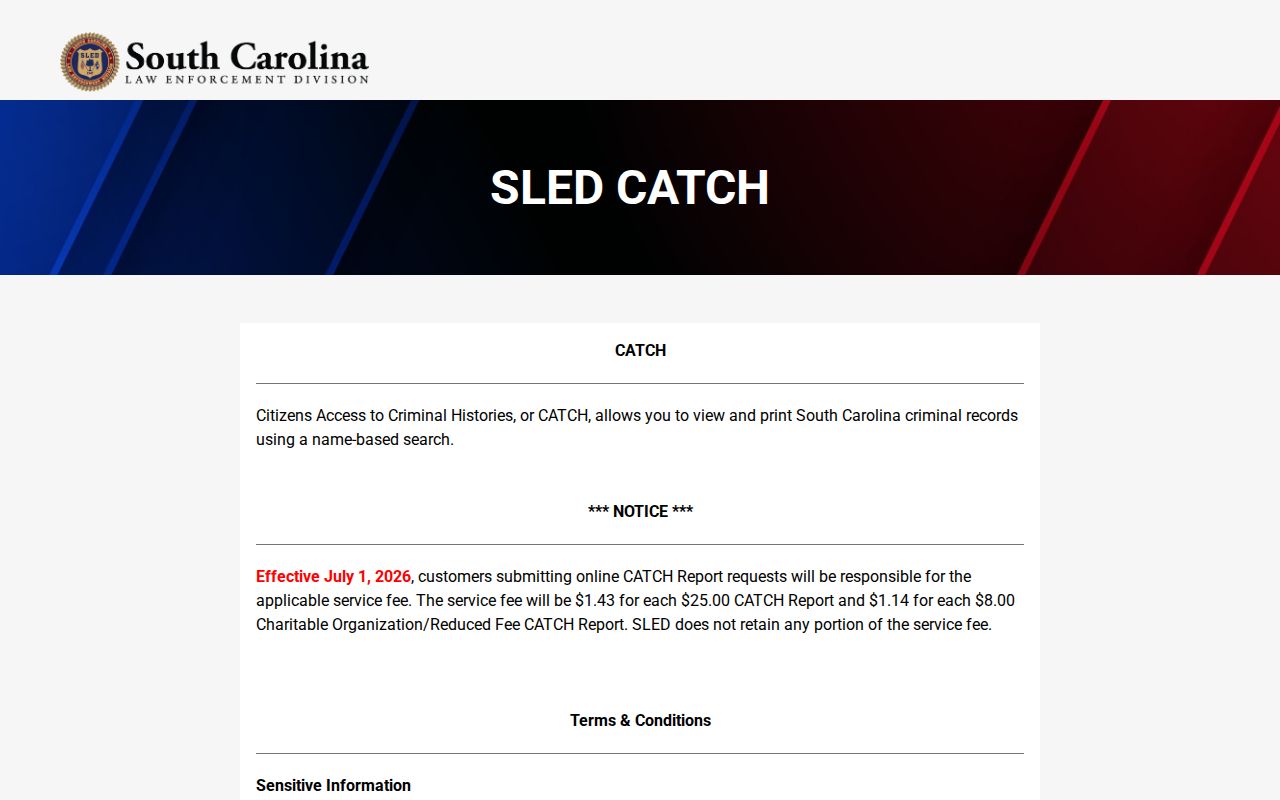
The screen’s fee and identity notices show why CATCH should be treated as one layer of an Abbeville County criminal record review.
A 2026 SLED report exposed a major reporting gap. SLED said fingerprints are the key that joins an arrest or direct indictment to computerized history, yet only seven percent of the 2025 direct indictments it examined had reached the repository at that point. Charge amendments and pleas can also need fresh fingerprint or disposition work. A no-result search therefore does not prove that no court case exists.
The SLED CJIS repository description explains the state record and correction role.
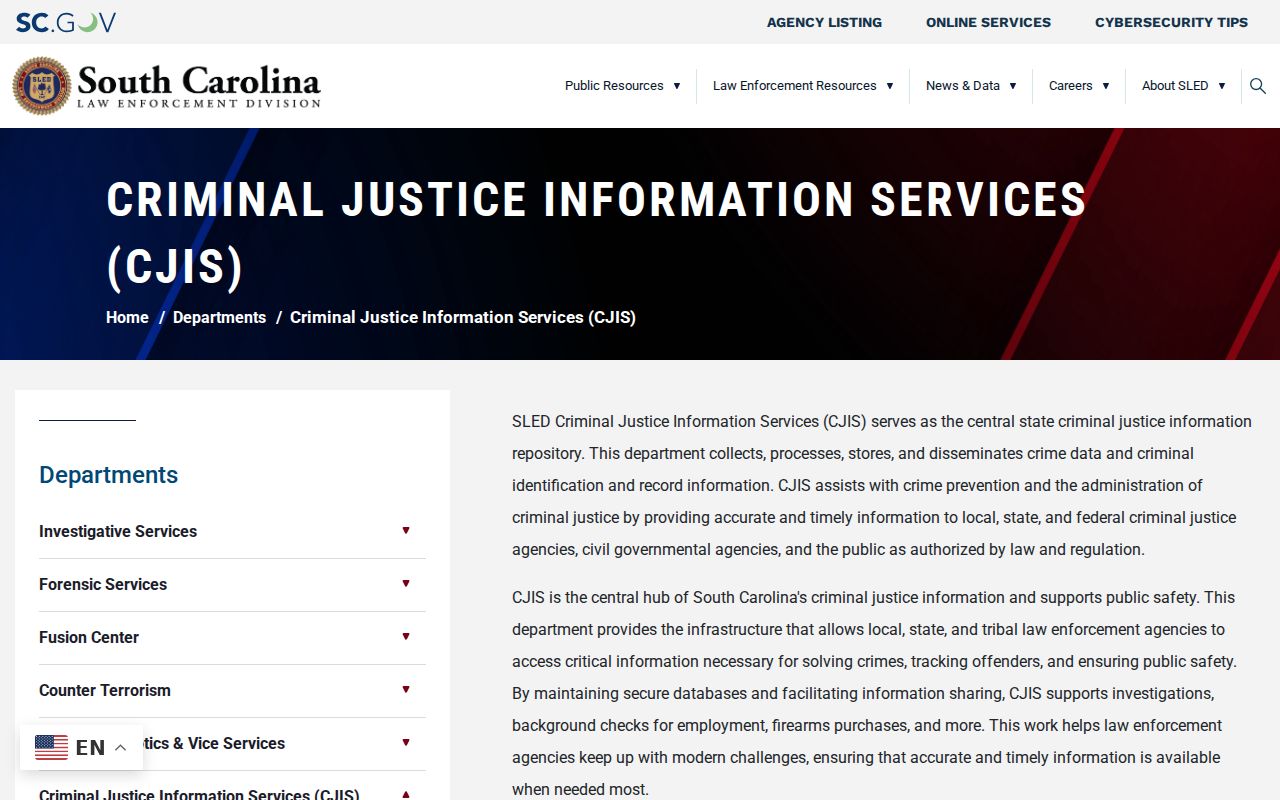
A person who finds stale or missing data should obtain a certified court disposition and follow SLED’s correction process.
Kinds of Criminal Records
Each Abbeville County custodian creates a record for a different stage. The police report states what an officer recorded about an incident. Detention creates the intake and custody entry. A court clerk tracks the filed charge and outcome. SLED compiles events that agencies connect through fingerprints and later reporting. SCDC covers current state-sentenced custody, while DPPPS handles community supervision.
- Incident and arrest report: the agency narrative, event facts, alleged offense, and officer action.
- Booking record: jail intake, initial charges, bond, prints, photograph, and release or transfer status.
- Court case file: warrants, filed charges, docket events, plea or trial, disposition, and sentence.
- Repository history: fingerprint-linked South Carolina arrest cycles and reported outcomes.
- Custody or supervision record: state prison placement or probation, parole, and related oversight.
Warrant and registry records form separate tracks. A public warrant portal was not found for Abbeville County. Call the issuing court or sheriff instead. Registry status must be checked in SORT because CATCH expressly excludes that search.
Abbeville County Custody Record Boundaries
No official Abbeville County online jail roster or booking log was located. To locate a recent detainee, call the Detention Center at 864-446-6200 with the person’s full name and any requested identifying detail. For a historical booking sheet, ask the sheriff or detention custodian about a focused written request. Do not replace that official chain with an aggregator.
The South Carolina Department of Corrections serves sentenced state custody rather than the Abbeville County jail.
SCDC’s locator excludes county-sentenced detainees, released people, juveniles, fugitives, and people who are only on probation or parole.
The correct custody chain is direct and short: arresting agency › Abbeville Detention Center › South Carolina Department of Corrections after a state-prison transfer. A person can leave county custody before appearing in the state system, especially during transport and intake. When timing is uncertain, call both custodians rather than treating either online absence as a final answer.
Abbeville County Criminal Records: What They Contain
An Abbeville County criminal record may display names and identifiers, but its layout depends on the custodian. A court file centers on one prosecution. A booking entry centers on intake and custody. A repository report groups reported arrest cycles under an identity. Read the field label and source before comparing two records.
| Name & Identifiers | Reported legal name, aliases, birth date, case number, booking number, SID, or fingerprint link. |
|---|---|
| Arrest / Booking Data | Arrest date, agency, intake time, alleged offense, warrant, bond, and custody action. |
| Charges & Statutes | Original or filed charge wording and the South Carolina law cited by the agency or court. |
| Disposition | Pending, dismissed, nolle prosequi, acquitted, guilty, or another recorded case result. |
| Sentence | Confinement, probation, fine, restitution, or other judgment terms when public. |
| Custody / Supervision | Current placement or court-ordered supervision, subject to the limits of each system. |
South Carolina does not place every offense into one simple felony or misdemeanor ladder. The exact charge statute supplies the penalty. General Sessions hears felony and serious matters, while magistrate and municipal courts generally hear summary offenses within their legal limits.
Abbeville County Supervision Record Snapshot
Probation and parole are state-run in Abbeville County. The South Carolina Department of Probation, Parole and Pardon Services office is at 903 W. Greenwood Street, Suite 2700, Abbeville, SC 29620. Its phone is 864-366-5323. There is no public county name search documented for this supervision data. The sentencing court remains the place to verify the order itself.
The official Abbeville DPPPS office page published a dated live supervision snapshot.
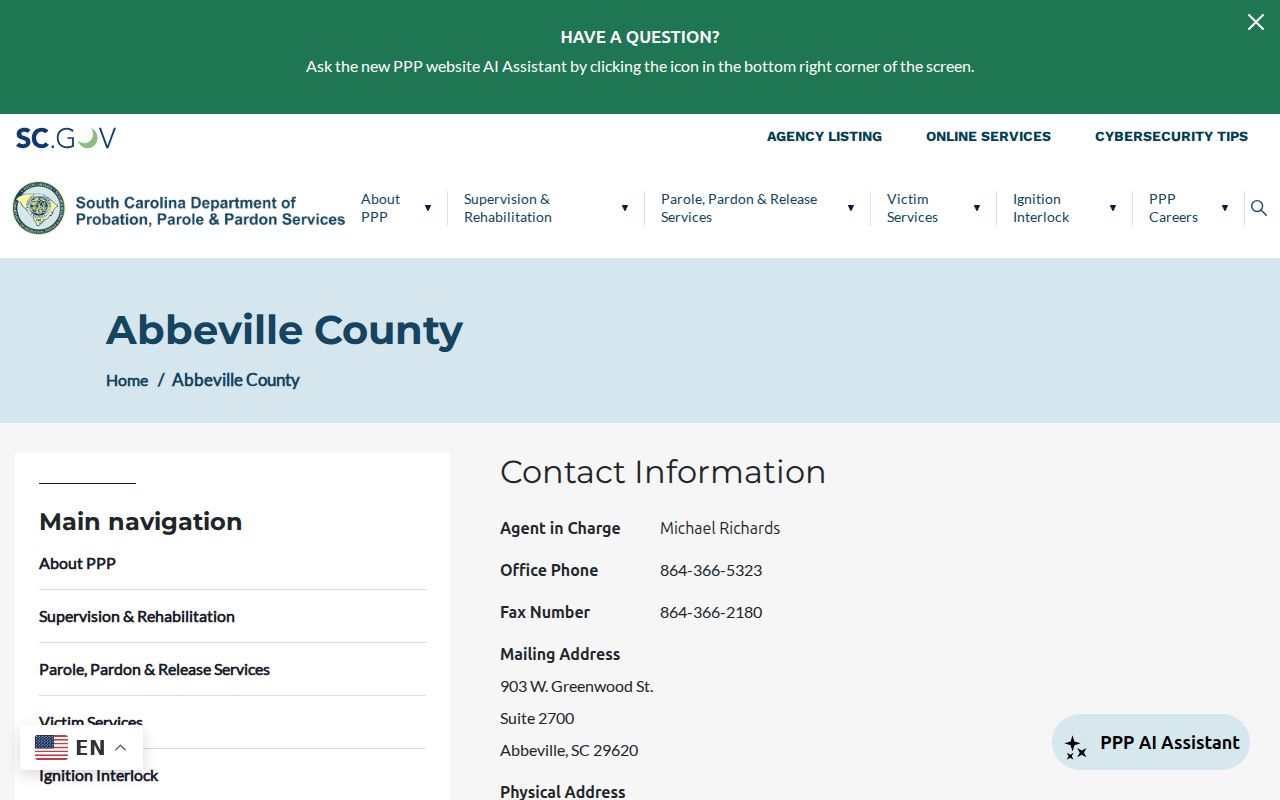
On July 29, 2026, it listed 125 probation cases, 8 parole cases, 5 community-supervision cases, 2 supervised-reentry cases, and 5 Jessie’s Law tracking cases. Those figures describe an agency workload on that date, not crime levels.
South Carolina Public Access Laws
The South Carolina Freedom of Information Act allows access to public agency records but also recognizes exemptions, response periods, and reasonable costs. A written Abbeville County request should name the record, date range, agency, event location, and known case or incident number. The agency generally has ten business days to decide whether recent records exist and are public, or twenty business days when the records are more than twenty-four months old. Production follows its own statutory period.
Key Statutes:
South Carolina FOIA sets public-record request duties, exemptions, time limits, and fee rules.
S.C. Code § 17-1-40 governs qualifying dismissed, discharged, and not-guilty charge records.
S.C. Code § 22-5-910 addresses certain first-offense summary-court expungements.
Uniform Expungement Act sets the solicitor-led administrative process.
S.C. Code Title 23, Chapter 3 governs criminal identification and public registry duties.
FOIA is not a shortcut to a certified court record. Police hold incident narratives, detention holds booking material, and the clerk certifies court documents. Active investigations, juvenile data, victim information, and protected identifiers may be withheld or redacted.
The official South Carolina public-access law page presents the governing text.
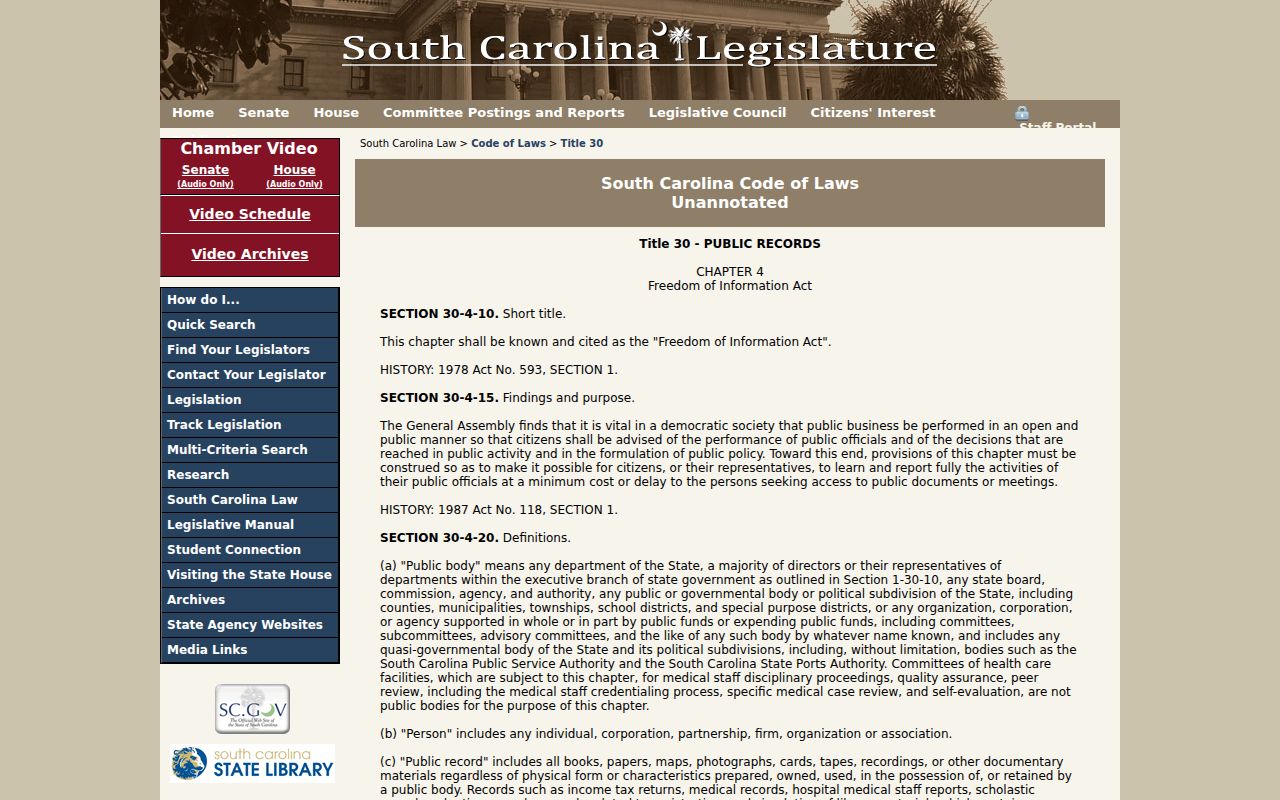
That statute supports focused requests but does not require an office to create a new report or legal analysis.
Abbeville County Court Record History
The county says the courthouse at Court Square was built in 1908, and it remains the General Sessions records landmark. The building’s age does not mean every old criminal case is online. Archive files, certified copies, and specific charge questions can still require direct work with the clerk. Bring the exact case number when possible and ask about retrieval and copy costs before ordering.
The Abbeville County Clerk of Court page identifies the courthouse, office hours, and the in-person rule for specific General Sessions charge information.
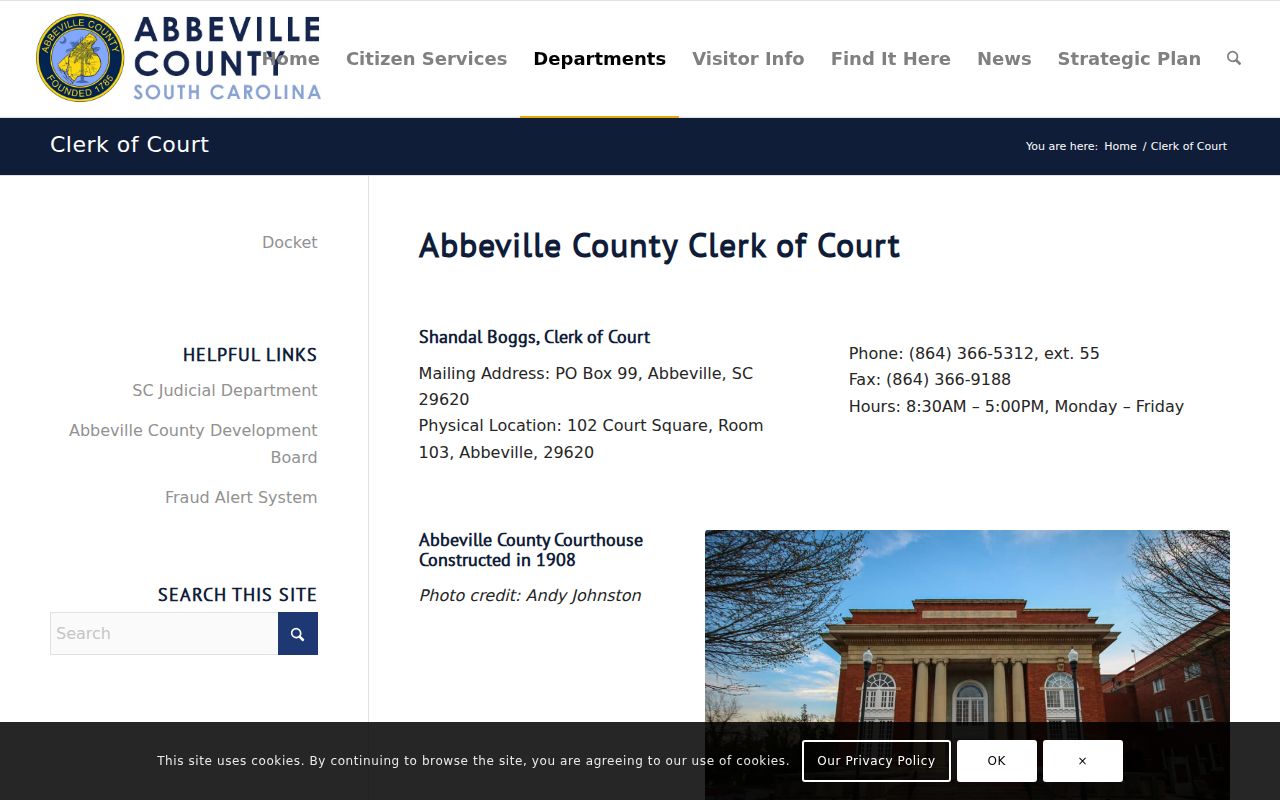
The courthouse view reinforces a key local fact: online dockets help find a case, but the clerk controls the authoritative file.
Restricted, Sealed & Expunged Records
Juvenile material, sealed or expunged files, protected victim data, Social Security numbers, and some active investigative records are not part of ordinary public access. Since January 1, 2026, the South Carolina Public Index also suppresses home addresses. A confidential reference list keeps protected identifiers outside the public e-file.
Expungement eligibility depends on the exact statute and outcome. Section 17-1-40 covers qualifying acquittals, dismissals, and discharged proceedings. Section 22-5-910 can cover a qualifying first summary conviction after the required period and conditions. Youthful-offender and diversion provisions follow different rules. Start an Abbeville County application through the Eighth Judicial Circuit Solicitor and obtain the case disposition from the correct clerk. The current full local fee was not found in official sources, so ask for the application and each charge before paying.
The dismissal and acquittal record law sets both public-record relief and limited sealed retention.
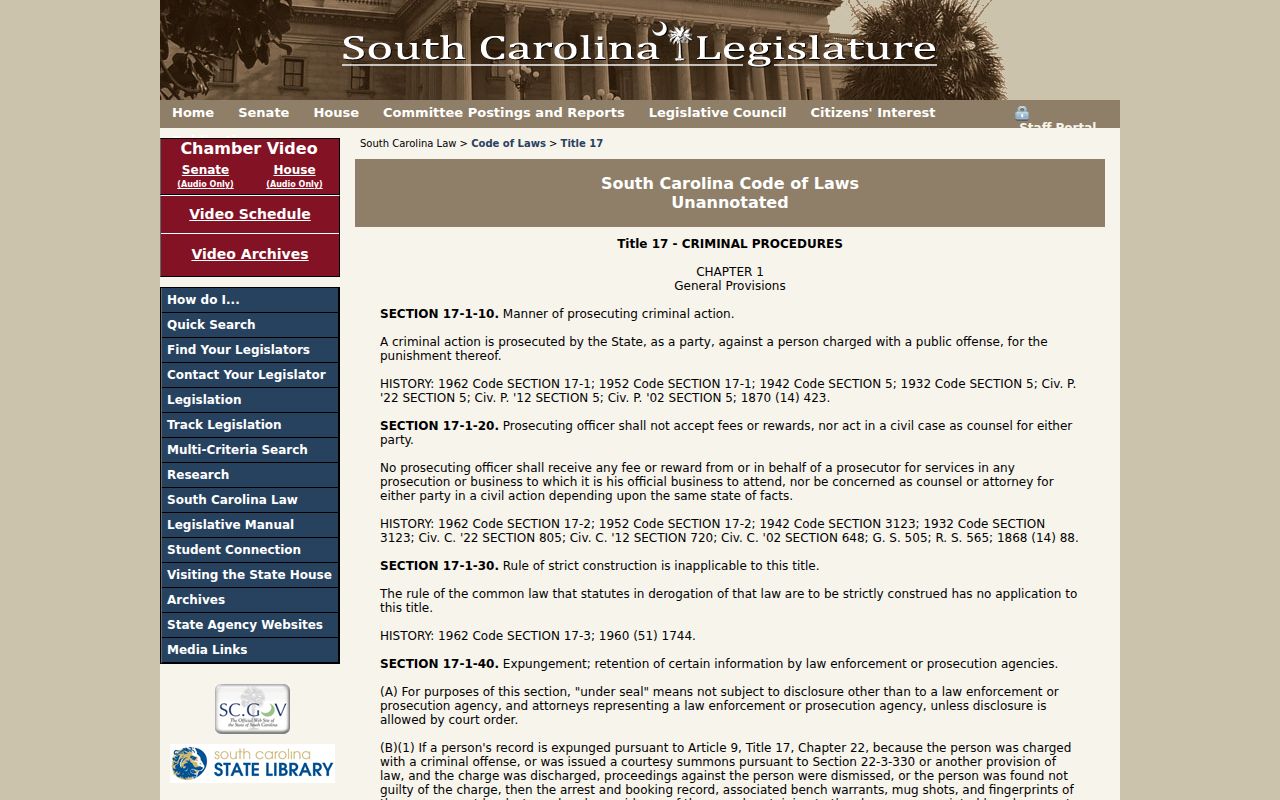
After an order, check both the court and a later SLED self-review because the repository may need a certified order to fix stale data.
Abbeville County Federal Record Layer
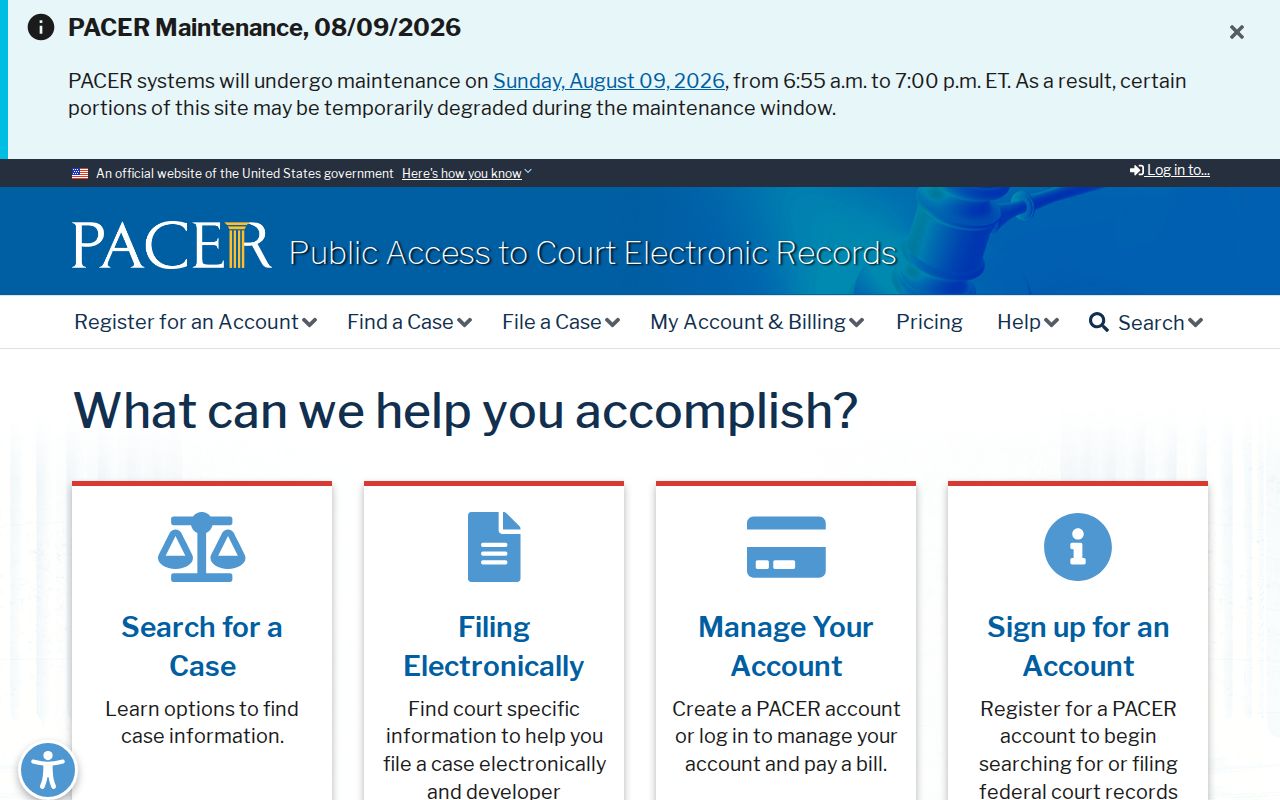
Federal records sit outside the county court index. Abbeville County is in the U.S. District Court for the District of South Carolina, and PACER is the official federal docket gateway. It requires registration and uses the current federal per-page billing rules. Confirm those charges on PACER before searching. A federal docket does not duplicate a county prosecution, and a county no-result does not rule out a federal case.
The PACER federal court gateway provides registration, search, and billing information.
The FBI Identity History Summary is a different subject-only, fingerprint-based product, while the Bureau of Prisons locator covers federal custody. Neither replaces an Abbeville County certified disposition.
City-by-City Criminal Records in Abbeville County
The county’s three largest incorporated places each add a local police or municipal-court layer. Abbeville has a named police Records Division and Summary Court. Calhoun Falls keeps its own police and municipal records but publishes no online town case portal. Due West uses county dispatch for reports while maintaining an independent police department and a municipal court listed in the statewide Public Index help.
Abbeville Record Check
Population 4,874 · Police Records Division, city Summary Court, and a $5 dissemination window.
Calhoun Falls Record Check
Population 1,701 · Direct police and municipal-court contact leads the town search.
Due West Record Check
Population 1,203 · County dispatch, town police, and Public Index municipal access work together.
Abbeville County Record Request Routing
A focused request saves time. For a sheriff incident, detention record, or releasable warrant item, begin with the Sheriff’s Office at 21 Old Calhoun Falls Road. Its fax is 864-446-6050 and its general email is info@abbevillecountysc.com. State the record type, date or range, location, involved agency, and known incident, case, or booking number. Ask for a cost estimate because no county copy-fee schedule was published.
Clerk of Court
102 Court Square, Room 103
Abbeville, SC 29620
864-366-5312
Monday-Friday, 8:30 a.m.-5 p.m.
Sheriff and Detention
21 Old Calhoun Falls Road
Abbeville, SC 29620
864-446-6000
Call first for the correct custodian.
Magistrate Court
21 Old Calhoun Falls Road
Abbeville, SC 29620
864-446-6500
Criminal clerk extension 2435.
A city police incident should go to that police department, not by default to the sheriff. A court filing goes to the clerk. The agency may redact active investigative facts, juvenile material, or protected identities, but it should identify the basis for withholding public-record material.